Whitchurch Station – Step-free Access
Latest Update (2026)
Plans to provide step-free access at Whitchurch (Shropshire) railway station have not progressed as hoped.
A lift scheme designed by Network Rail, working with Transport for Wales (TfW), has been dropped from the UK Government’s accessibility funding programme. The latest list dates Published 24 May 2024 is on a link further down.
There is currently no confirmed funding or delivery timetable.
Comparing Annual Passenger Use
Whitchurch’s annual passenger numbers (approx. 164,000) place it squarely within the range of other UK stations that have received Access for All funding, or been shortlisted for improvements. Nearby examples include Bodmin Parkway (≈305,000), Castle Cary (≈355,000), Shotton (≈209,000) and Ruabon (≈117,000). These stations serve similar community and regional roles, yet have either benefited from step‑free access improvements or been actively considered for them, demonstrating that Whitchurch’s usage is well within the scope of stations normally prioritised for accessibility investment.
The Case for Action
Step-free access at Whitchurch has been discussed for years.Passenger numbers are rising, but accessibility remains unchanged.
A practical and deliverable solution is needed.
Future Passenger Growth at Whitchurch
Passenger numbers at Whitchurch (Shropshire) station have risen strongly in recent years — from around 135,000 in 2023‑24 to about 164,000 in 2024‑25, marking over a 20% year‑on‑year increase. This recovery mirrors wider UK rail usage trends, where passenger journeys have moved back toward (and in some areas exceed) pre‑pandemic levels.
If Whitchurch continues to grow even modestly (around 10% per year), the station could see 180,000–220,000 passengers per year within two or three years. Under stronger growth scenarios, annual usage could approach 250,000 or more by the late 2020s.
These projections highlight that demand for rail travel at Whitchurch is not static but rising, reinforcing the case for properly accessible facilities.
Key points
- Whitchurch is not uniquely small or low‑usage — it falls in a band that other funded stations occupy.
- Many funded stations handle between ~100,000 and 400,000 passengers/year — exactly where Whitchurch sits.
The Problem
There is no step-free access to the Shrewsbury-bound (southbound) platform.
- Travel to another station (such as Shrewsbury or Nantwich)
- Cross platforms there
- Return on the next train
This is not a reasonable workaround and limits independent travel.
The MP speaks out
“Whitchurch… does not have step‑free access from the southbound platform… Those who are disabled or elderly… are often physically unable to access half of the trains.”
— Helen Morgan MP, House of Commons debate, Nov 2025. Helen Morgan MP, has repeatedly raised the lack of step‑free access at Whitchurch with ministers in Parliament, describing local access to rail services as ‘very poor indeed’ and highlighting the practical exclusion faced by disabled and elderly passengers.”
TfW perspective
Transport for Wales states that it is “committed to excellent service for all our customers” and is working with rail industry partners and the Welsh Government to improve accessibility of services and facilities across the network. On its own station accessibility listings, TfW classifies Whitchurch (Shropshire) as Category B3, meaning only one platform currently has step‑free access (to Crewe), and the Shrewsbury‑bound platform is only reachable by a footbridge with 44 steps.
- There is no recent public TfW statement confirming funding or delivery of lifts at Whitchurch.
- The language guiding TfW’s accessible travel policy focuses on assistance on trains and at stations, and overall commitment to accessibility, not station works pipelines. They can get you on and off the train but not over the footbridge.
Current Access
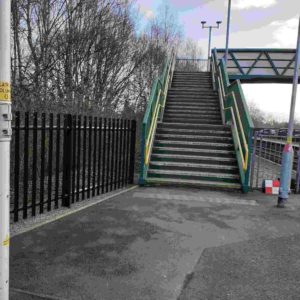
Access between platforms is only via a footbridge with stairs.
There are no lifts and no step-free route.
Why This Matters
- Increasing passenger numbers
- Regular stopping services
- Long-distance trains serving the station
Accessibility has not kept pace with usage.
What Was Proposed
- Lifts at the existing footbridge
- Design led by Network Rail
- Supported by Transport for Wales
This would have provided full step-free access — but the scheme is currently unfunded.
Practical alternatives
Embankment Access Route
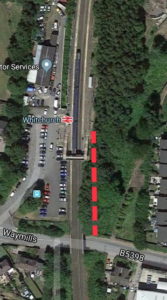
A new path could be created from the road up to the platform, using a gradual slope.
- Direct step-free access
- Uses existing railway land
- Potentially lower cost build and operation than lifts
Constraints: Limited space at road level; may require minor road adjustments.
Platform Ramps
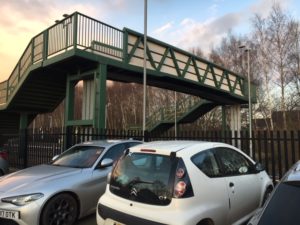 Ramps to access the footbridge
- Space on the Shrewsbury side
- Limited space on the Crewe side (possible parking impact)
Further Information
- Transport for Wales accessibility
- Network Rail access for all scheme
- Department for Transport – Access for All
- Railway stations awarded access for all accessibility funding 2024
- National Rail station information
This is an extract from the Department for Transport pages
Improving the accessibility of our stations and trains
Many of Great Britain’s 2,581 railway stations were constructed before modern accessibility standards were established, making them challenging to navigate for many disabled people.
Taking recently updated data from our (DfT’s) audit, approximately 56% of stations and around 66% of the 1.3 billion journeys that take place on the network have step-free access to platforms.
Level-boarding (street-to-seat independence) is rare, present at just 4% of stations.
To address this, the following actions are being taken:
Increasing the number of stations with step-free access to the platform
Delivery lead Network Rail, ongoing to 2029.
£373 million has been committed over the next 5 years to deliver Access for All projects, providing step-free access from station entrances to and between platforms, alongside other essential accessibility upgrades. These works, together, will increase the number of step-free stations across Great Britain from 56% to 58%.
This improvement will make travel easier with step-free access available at stations covering an increased share of total rail journeys – from 66% up to 71% – based on 23/24 ticket sales data.
These improvements are coupled with step-free schemes at stations delivered through major rail investments such as the TransPennine Route Upgrade and East West Rail, which will further increase the number of stations that are step-free. A dedicated national programme office will maintain oversight of the programme’s delivery, with clearer and more transparent reporting of progress accessible to the public.
Reforming the Access for All Programme
To end the short-term, stop-start approach to accessibility improvements, we aim to transition to a rolling programme with a commitment of up to £70 million per year.
This sustained funding will enable more efficient long-term planning and delivery, providing greater certainty for the programme and the supply chain that supports it.
As part of the establishment of Great British Railways, we will also undertake a broader reform of the Access for All programme. This will be shaped through consultation with disabled people and local transport bodies, ensuring their voices directly influence how the programme develops in future.
